










![How to Start an Ecommerce Business in Australia [2023 Guide]](/template/e27cf56f/images/resource-blog-right-img1.png)



Creating the right conditions for B2B ecommerce
Picture this: you finally launched your B2B ecommerce platform. The website looks perfect, all the catalogues are live, and initial traffic has started rolling in. But over time, orders are slowing, customer inquiries are increasing, and your team is spending more time fixing backend issues than closing deals.
The truth is, success in B2B ecommerce isn't just about going digital; it's about creating the right conditions. It's about how you are aligning technology, data, and customer experience. It relies on making your platform an extension of your sales team, not a separate tool.
In short, every element needs to function in harmony.
In this article, we'll break down the essential conditions that can help a B2B ecommerce business not only survive online but scale sustainably.
You have to understand the modern B2B buyer
The expectations of B2B buyers have changed over time. Similar to the everyday customers, today's business customers are also influenced by their experiences. They look for the same level of convenience, speed, and personalisation, just like they experience when shopping on B2C platforms.
Digital-first interactions lead the list of their preference as everything happens online, from researching to comparing prices to making purchase decisions. So, intuitive, informative, and user-friendly your online store has to be to capture their attention early in the buying journey.
Some of the other key expectations include:
Self-service feature: Most of today's buyers want to browse catalogues, generate quotes, and place bulk orders all by themselves instead of relying on constant sales support.
Transparent pricing: It is clear and consistent pricing that builds trust and helps modern buyers to make quicker decisions. If there are any hidden or inconsistent costs, it can easily turn them away.
Seamless checkout: The buying process has to be smooth and efficient. It also needs to support multiple payment options, negotiated terms, and easy reordering.
Quick support: Availability of customer service through live chat, email, or phone call makes a huge difference when resolving queries or managing orders.
Choose the right B2B model
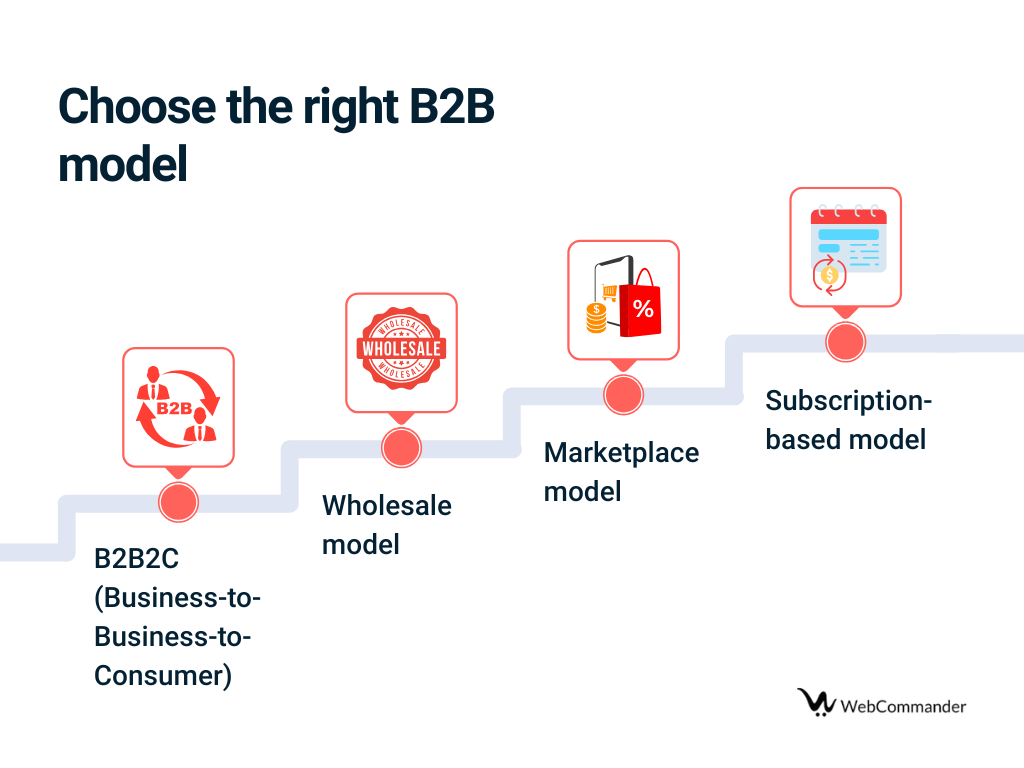
If you want to ensure long-term success, you have to pick the right B2B ecommerce model. The right B2B model can have a huge impact on a business's scalability, operations, and customer engagement.
Some of the most common B2B ecommerce models include:
B2B2C (Business-to-Business-to-Consumer): In this model, a business first sells products to another business. Then they sell it to the end consumer. It eventually combines wholesale distribution with direct-to-consumer reach, allowing for greater brand control and customer data access.
Wholesale model: This is the most traditional B2B structure. The companies sell products in bulk to retailers, resellers, or other businesses. It emphasises volume-based pricing, inventory management, and long-term client relationships.
Marketplace model: Businesses use a shared online platform alongside other vendors to sell their products. The marketplace model benefits businesses by providing broader market exposure and lower entry costs, though it also comes with competitive pricing pressures.
Subscription-based model: This model is ideal for businesses that offer recurring products or services, such as software or consumables. If managed well, businesses can ensure predictable revenue and strong customer retention.
Build a scalable B2B ecommerce infrastructure
A strong infrastructure is the backbone of any successful B2B ecommerce operation. Unlike B2C, transactions in B2B involve bulk ordering, negotiated pricing, custom workflows, and ongoing client relationships. To support this complexity, businesses need to pick the right ecommerce platform to ensure seamless system integrations for scalability and efficiency.
Choose the right ecommerce platform
You need to start by selecting a platform that will grow with your business. You have to check whether it can handle large product catalogues, manage tiered pricing, support multiple users per account, and automate repetitive tasks.
Features such as inventory synchronisation, advanced order management, and flexible payment terms add the plus that comes with every advanced platform. Go for the platforms that offer built-in automation and easy integration with business systems so that you can skip much manual effort while improving accuracy.
Keep focus on system integrations
System integration is key when it comes to creating a unified digital ecosystem. If you connect your ecommerce platform with tools such as ERP (Enterprise Resource Planning), CRM (Customer Relationship Management), and accounting software, there will be smooth data flow between departments. There will be less need for manual data entry.
Adopt headless commerce
Most modern B2B companies are increasingly adopting API-driven and headless commerce architectures, as it allows developers to update or customise the user interface without disrupting core business processes. APIs act as bridges here, ensuring smooth data flow to any customer-facing touchpoint, whether it's a website, mobile app, or marketplace.
If your business goal is to deliver personalised experiences faster, scale easily across multiple channels, and adapt quickly to changing market demands, this approach will work best for you.
Make a data-driven decision
In B2B ecommerce, data is the foundation for smarter, faster, and more confident decisions. From every click to each single search, to any transaction, all offer valuable insights and help businesses to refine strategies and improve performance.
You can understand buyer behaviour through analytics, such as identifying their purchasing patterns or the most-viewed products, or finding out the factors that influence them to make repeat orders. Similarly, you can track sales performance and inventory trends to maintain stock efficiency in your business while avoiding overselling and responding quickly to demand shifts.
Plan dynamic pricing strategies so that you can adjust prices based on real-time market conditions, customer type, or order volume. Follow strong data governance practices to ensure that data is clean, consistent, and accessible to the right teams. Implement real-time analytics tools to get instant visibility into performance metrics.
Create a seamless customer experience

A smooth, user-friendly experience is the key to B2B ecommerce success. Personalisation matters in B2B settings. From tailor catalogues to custom pricing to product suggestions, you can try out many options. If you show only relevant items or offer custom discounts, it will not build trust, but speed up decision-making as well.
Your website must be clutter-free and organised. Especially for those with complex catalogues or large product ranges and technical details, you must ensure intuitive navigation by enabling effective filters and detailed product pages.
Speed and mobile responsiveness are non-negotiable when creating a hassle-free customer experience. Your web pages need to load fast and look great on any device.
Build trust through security and compliance
Trust is the pillar of every successful B2B relationship. Since B2B transactions often involve large orders, sensitive data, and long-term partnerships, even a small mistake can lead to serious consequences. That is why maintaining strong security measures is not just a technical requirement; it's a business necessity.
When selecting a B2B ecommerce platform, you must check what measures it takes to save your business and your clients from data breaches, financial fraud, and identity theft. Check whether they maintain advanced security protocols such as SSL encryption, two-factor authentication, and regular vulnerability assessments.
Businesses also need to ensure secure access control across departments and partners to eliminate any sort of unauthorised data exposure.
Data protection and compliance are other necessary aspects. Companies need to comply with international standards to protect customer privacy. These frameworks handle and store any sensitive data—like client information, billing details, and payment credentials securely.
Invest in continuous optimisation
B2B ecommerce success isn't just a one-time achievement; rather, it's an ongoing process that needs consistent testing, evaluation, and improvement. As the digital landscape evolves rapidly, customers' expectations also shift just as fast.
An effective way to consistently improve your online performance is through A/B testing. For example, you can do it by comparing two versions of a page, product listing, or checkout flow, and identify the right elements that drive better engagement or conversions.
It is also essential to maintain feedback loops with your customers. Use surveys, chatbots, or post-purchase forms to collect feedback and uncover usability issues and areas for improvement.
Run performance audits on a regular basis to assess your site's speed, functionality, SEO performance, and security posture. Remember that even a small improvement, such as optimising an image or updating outdated plugins, can make a huge difference. Eventually, the most successful B2B brands don't just react to change—they anticipate it.
Final words
So, try it out and start viewing your ecommerce platform as a living system that will evolve through data, feedback, and innovation. Keep your focus on the core conditions and stay open to change. This will enable your business to be better prepared to handle new challenges and opportunities in the digital marketplace.
In the end, success comes down to consistency, adaptability, and a genuine focus on delivering value to every customer.


